

Introduction
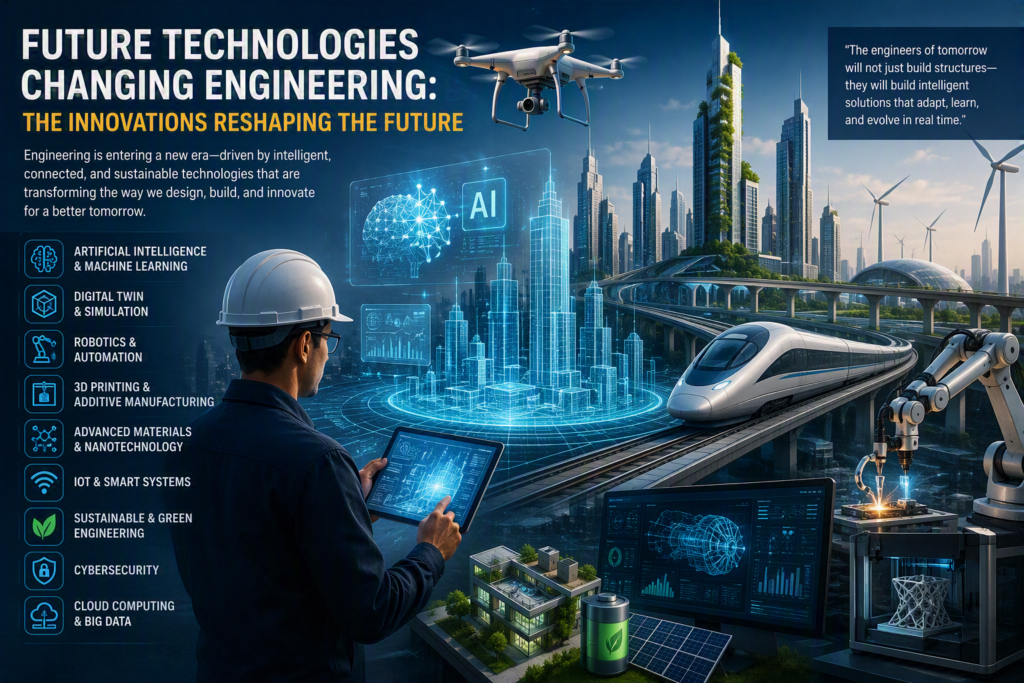
Engineering has always been at the heart of human progress. From the construction of ancient civilizations to the development of modern cities, transportation systems, communication networks, and industrial infrastructure, engineering has continually evolved to solve challenges and improve the quality of life. Today, however, the profession is entering one of the most transformative periods in its history.
The convergence of artificial intelligence, automation, digital technologies, advanced materials, smart systems, and sustainable solutions is creating a new era of engineering. Traditional approaches based primarily on manual calculations, physical testing, and isolated workflows are rapidly being replaced by intelligent, connected, and data-driven processes.
The engineers of tomorrow will not simply design products, structures, and systems. They will create intelligent solutions capable of adapting, learning, optimizing, and evolving in real time.
Understanding these emerging technologies is becoming essential for engineering students, professionals, educators, and organizations seeking to remain competitive in an increasingly digital world.
This article explores the most important future technologies changing engineering and examines how they are reshaping industries, redefining professional roles, and creating new possibilities for innovation.
What Are the Future Technologies Changing Engineering?
Future technologies changing engineering include:
- Artificial Intelligence (AI)
- Digital Twins
- Building Information Modeling (BIM)
- Internet of Things (IoT)
- Robotics and Automation
- Smart Manufacturing
- Industry 4.0
- Additive Manufacturing (3D Printing)
- Augmented Reality (AR)
- Virtual Reality (VR)
- Renewable Energy Technologies
- Advanced Materials
- Quantum Computing
- Sustainable Engineering Solutions
Together, these technologies are making engineering more intelligent, efficient, sustainable, and collaborative than ever before.
Artificial Intelligence in Engineering
Artificial Intelligence is no longer a futuristic concept. It is rapidly becoming one of the most powerful tools available to modern engineers.
AI enables machines and software systems to analyze data, identify patterns, make predictions, and assist in decision-making. Engineers can leverage AI to improve design processes, optimize performance, reduce risks, and accelerate project delivery.
AI-Powered Design
Traditional engineering design often requires extensive calculations and countless iterations. AI-driven design platforms can analyze thousands of design possibilities within minutes and identify the most efficient solutions.
Benefits include:
- Faster design development
- Reduced material usage
- Improved structural performance
- Better energy efficiency
- Cost optimization
Generative design software is already helping engineers create innovative products that would be difficult using conventional methods.
Predictive Maintenance
AI can monitor equipment performance, identify unusual behavior, and predict failures before they occur.
Industries such as manufacturing, transportation, energy, and construction use predictive maintenance systems to:
- Reduce downtime
- Improve reliability
- Lower maintenance costs
- Extend equipment lifespan
Rather than fixing problems after failure, engineers can address issues before they become critical.
Future Impact
As AI continues to evolve, engineers will increasingly use intelligent systems to support design, simulation, project management, and operational decision-making.
Digital Twins: Virtual Replicas of Physical Systems
Digital Twin technology is transforming how engineers manage assets throughout their lifecycle.
A digital twin is a virtual representation of a physical system, structure, process, or asset that continuously receives data from the real-world counterpart.
Examples include:
- Buildings
- Bridges
- Manufacturing plants
- Aircraft
- Power stations
- Transportation networks
Digital twins allow engineers to:
- Monitor performance in real time
- Simulate operating conditions
- Predict failures
- Optimize maintenance schedules
- Reduce operational risks
By combining real-world data with advanced simulation capabilities, digital twins provide unprecedented visibility into complex systems.
As smart infrastructure becomes more common, digital twins are expected to become standard practice across engineering industries.
Building Information Modeling (BIM)
Building Information Modeling has revolutionized the construction and infrastructure sectors.
Unlike traditional CAD drawings, BIM creates an intelligent digital model containing detailed information about every aspect of a building or infrastructure project.
BIM integrates:
- Design information
- Engineering data
- Cost information
- Scheduling details
- Material specifications
- Maintenance records
Why BIM Matters
BIM improves:
- Collaboration among project teams
- Project visualization
- Clash detection
- Cost estimation
- Construction planning
- Facility management
As BIM systems become more advanced, they are increasingly integrating with digital twins, AI, and IoT technologies to create truly intelligent infrastructure.
The Internet of Things (IoT)
The Internet of Things refers to a network of connected devices that collect, exchange, and analyze data.
In engineering, IoT technology enables real-time monitoring of systems and assets through embedded sensors and connected devices.
Applications include:
Smart Buildings
Sensors monitor:
- Occupancy
- Lighting
- HVAC systems
- Energy consumption
This improves operational efficiency and occupant comfort.
Infrastructure Monitoring
Bridges, tunnels, dams, and transportation systems can continuously transmit data regarding:
- Structural health
- Stress levels
- Vibration
- Environmental conditions
This allows engineers to detect issues early and improve safety.
Industrial Systems
Connected equipment helps organizations:
- Track performance
- Optimize production
- Improve maintenance planning
- Increase efficiency
IoT is helping transform engineering systems from reactive to proactive and predictive.
Robotics and Automation
Automation has long been part of engineering and manufacturing. Today’s advanced robotics, however, are taking productivity and precision to entirely new levels.
Industrial Robotics
Modern robots perform tasks such as:
- Welding
- Assembly
- Inspection
- Material handling
- Packaging
These systems improve consistency and safety while reducing human exposure to hazardous environments.
Collaborative Robots
Collaborative robots, commonly known as cobots, work alongside human operators.
Unlike traditional robots confined within safety barriers, cobots support workers by handling repetitive tasks and assisting with precision operations.
Benefits include:
- Improved productivity
- Enhanced flexibility
- Better workplace ergonomics
- Reduced fatigue
Robotics in Construction
Emerging technologies include:
- Robotic bricklaying systems
- Autonomous excavation equipment
- Drone-based site inspections
- Automated surveying systems
These innovations are redefining how infrastructure projects are executed.
Smart Manufacturing and Industry 4.0
Industry 4.0 represents the integration of digital technologies into manufacturing environments.
The concept combines:
- Artificial Intelligence
- IoT
- Robotics
- Cloud Computing
- Data Analytics
- Automation Systems
The result is a smart factory capable of monitoring, analyzing, and optimizing operations in real time.
Benefits of Smart Manufacturing
- Increased productivity
- Reduced downtime
- Improved product quality
- Better resource utilization
- Enhanced operational visibility
Manufacturing facilities are becoming more adaptive, efficient, and intelligent.
Engineers with expertise in Industry 4.0 technologies will be in high demand in the coming years.
Additive Manufacturing and 3D Printing
Additive Manufacturing, commonly known as 3D Printing, is changing how products are designed and produced.
Unlike traditional manufacturing, which removes material, additive manufacturing builds objects layer by layer.
Advantages
- Reduced waste
- Faster prototyping
- Greater design flexibility
- Mass customization
- Lower development costs
Engineering Applications
Industries using additive manufacturing include:
- Aerospace
- Automotive
- Medical Devices
- Construction
- Consumer Products
Engineers can create highly complex geometries that would be difficult or impossible using conventional methods.
As technology advances, large-scale 3D printing may transform how infrastructure and buildings are constructed.
Augmented Reality and Virtual Reality
Augmented Reality and Virtual Reality are creating new possibilities for engineering design, training, and project visualization.
Virtual Design Reviews
Engineers can experience projects in immersive virtual environments before construction begins.
This helps teams:
- Identify design conflicts
- Improve collaboration
- Reduce rework costs
Training and Education
Virtual environments provide realistic simulations for:
- Equipment operation
- Safety training
- Maintenance procedures
- Technical education
Field Applications
Augmented Reality allows technicians to view real-time information superimposed on physical equipment.
This improves:
- Maintenance efficiency
- Inspection accuracy
- Troubleshooting effectiveness
AR and VR technologies are expected to become increasingly common across engineering disciplines.
Renewable Energy Technologies
The transition toward sustainable energy is one of the biggest engineering challenges and opportunities of the modern era.
Engineers are leading the development of technologies that reduce carbon emissions and improve energy efficiency.
Solar Energy
Advancements in photovoltaic technology continue to improve:
- Conversion efficiency
- Affordability
- Reliability
Wind Energy
Modern wind turbines are becoming:
- Larger
- More efficient
- More cost-effective
Energy Storage
Innovations in battery technology enable:
- Better energy management
- Improved grid stability
- Greater renewable energy adoption
The renewable energy sector will remain a major source of engineering innovation for decades to come.
Sustainable Engineering
Sustainability is no longer an optional consideration. It has become a core engineering requirement.
Future engineering projects must balance:
- Economic performance
- Environmental responsibility
- Social impact
Key focus areas include:
Green Buildings
Designing structures that:
- Reduce energy consumption
- Improve efficiency
- Minimize environmental impact
Sustainable Infrastructure
Building systems that support long-term environmental and economic goals.
Circular Engineering
Designing products and processes that reduce waste through reuse, repair, recycling, and resource optimization.
Sustainable engineering is helping create a future that is both innovative and environmentally responsible.
Advanced Materials Engineering
New materials are opening possibilities that were previously unimaginable.
Engineers are developing materials that are:
- Stronger
- Lighter
- More durable
- More sustainable
Examples include:
Graphene
A revolutionary material known for its exceptional strength, conductivity, and flexibility.
Smart Materials
Materials that respond to environmental conditions such as temperature, pressure, and stress.
Advanced Composites
Used extensively in aerospace, automotive, and renewable energy applications due to their high strength-to-weight ratio. These innovations are enabling engineers to build more efficient products and infrastructure.
Quantum Computing
Quantum Computing remains an emerging technology, but its potential impact on engineering is enormous.
Unlike traditional computers, quantum computers can process certain types of calculations far more efficiently.
Potential applications include:
- Material discovery
- Structural optimization
- Complex simulations
- Logistics optimization
- Energy system modeling
Although widespread adoption may still be years away, quantum computing could eventually transform engineering analysis and research.
Cybersecurity in Engineering
Engineering systems are becoming increasingly connected.
Smart factories, intelligent buildings, transportation systems, and industrial infrastructure all rely on digital networks and data.
This growing connectivity introduces cybersecurity challenges.
Engineers must now consider:
- Data protection
- System integrity
- Network security
- Risk management
- Cyber resilience
Future engineering projects will require a combination of physical and digital security strategies. Cybersecurity is becoming an essential engineering competency.
Skills Future Engineers Need
Technology is transforming engineering, but human expertise remains crucial.
To succeed in the future, engineers must combine technical knowledge with digital skills and adaptability.
Technical Skills
- Engineering fundamentals
- Design principles
- Simulation and analysis
- Project management
Digital Skills
- Artificial Intelligence
- Data Analytics
- BIM Technologies
- IoT Systems
- Automation Platforms
Human Skills
- Problem-solving
- Creativity
- Communication
- Leadership
- Collaboration
- Critical Thinking
The engineers who thrive in the future will be those who embrace continuous learning and remain adaptable to technological change.
Challenges and Opportunities Ahead
While emerging technologies offer tremendous benefits, they also create challenges.
Organizations must address:
- Workforce reskilling
- Technology integration costs
- Data privacy concerns
- Ethical considerations
- Regulatory compliance
- Cybersecurity risks
At the same time, these technologies create opportunities for innovation, productivity, sustainability, and economic growth.
Engineering has always evolved to meet society’s needs, and the current wave of technological advancement is no exception.
Conclusion
The future of engineering is being shaped by a remarkable combination of intelligent technologies, digital systems, and sustainable innovations.
Artificial Intelligence, Digital Twins, BIM, IoT, Robotics, Smart Manufacturing, Additive Manufacturing, Renewable Energy, Advanced Materials, and Quantum Computing are not simply improving engineering processes. They are fundamentally redefining what engineers can achieve.
Tomorrow’s engineers will design smarter cities, create cleaner energy systems, develop advanced manufacturing environments, build intelligent infrastructure, and solve challenges that previous generations could only imagine.
The future belongs to engineers who are willing to learn, adapt, and innovate.
As technology continues to evolve, one thing remains unchanged: engineering will remain the discipline that transforms ideas into reality and drives human progress forward.
The future of engineering is smarter, more connected, more sustainable, and more exciting than ever before.
Leave a Reply